 DrivePulse
What do you need to read codes with an iPhone?
- A car with an OBD2 port: in the US every car since 1996, in Europe petrol cars since 2001 and diesels since 2004.
- An ELM327 adapter with Bluetooth LE or Wi-Fi, for example the Veepeak OBDCheck BLE or the Vgate iCar Pro 2S. Classic Bluetooth adapters don't work on iPhone with any app.
- An app that talks to the adapter, such as DrivePulse.
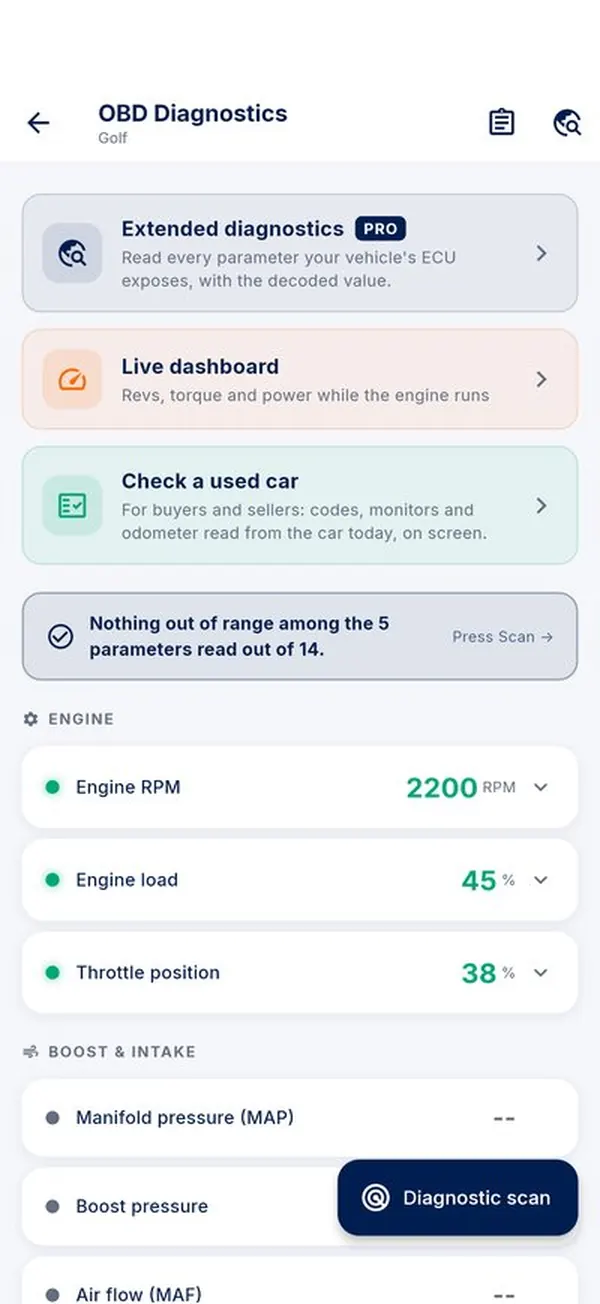
How do you read them, step by step?
- Find the OBD2 port: it's usually under the steering wheel, sometimes behind a small cover.
- Plug in the adapter and switch the ignition on. The engine can stay off.
- Open DrivePulse, go to Connect adapter and tap Search devices. The first connection can take up to a minute and a half.
- Open the fault codes: the app reads the engine codes. In the used car check it also reads those of the other control units it knows for that brand, such as the gearbox or ABS.
For each code DrivePulse tells you what it means, how urgent it is and what to do. We write the explanations ourselves, and they don't replace the manufacturer's manual.
What does a code like P0420 mean?
A code has five characters. The letter is the system: P engine and transmission, C chassis, B body, U communication between control units. If the second digit is 0 the code is generic, the same for every brand; if it's 1 it's specific to the manufacturer. The last digits point to the component and the kind of fault.
A code tells you where to look, not what to replace. P0420, for example, means catalyst efficiency below threshold: it can be the catalytic converter, but also an oxygen sensor or an exhaust leak.
Stored, pending and permanent codes: what's the difference?
- Stored: the fault has been confirmed, and it's often the one that turned the light on.
- Pending: the ECU has seen it once and is keeping an eye on it.
- Permanent: it stays stored even if someone clears the codes, until the ECU itself confirms the fault is fixed.
Steady or flashing check engine light: what's the difference?
A steady light means the ECU has stored a fault: you can usually finish your trip, but it's worth reading the code soon and having it looked at. A flashing light is more serious: it usually means heavy misfires, which can damage the catalytic converter. In that case ease off, avoid hard acceleration and stop as soon as you can.
Either way, reading the code helps you understand who to talk to and what to ask, before you even get to the garage.
Should you clear the code?
Clearing turns the light off, it doesn't fix anything: if the fault is still there, the code comes back. Clearing also resets the readiness monitors, the self-checks the ECU runs while you drive, which then take days to complete. That's why DrivePulse is read-only and doesn't clear codes: it reads, explains and leaves the decision to you.
When you go to the garage, DrivePulse has a sheet for the mechanic: codes, permanent codes, freeze frame and engine data, as a PDF or a spreadsheet. The freeze frame records speed, temperature and load at the moment the fault was stored.
Frequently asked questions
Can I read codes with the engine off?
Yes. Ignition on and the car stopped is enough. With the engine running you also get the live values.
The light is off but there's a code: is that normal?
Yes. A pending code, or a fault that doesn't turn the light on, stays stored. Reading them before the light comes on is exactly what an OBD2 reader is good for.
Can reading codes damage the car?
No. Reading asks the ECU what it has stored and changes nothing. DrivePulse never writes to the ECU.
Where is the OBD2 port?
Usually under the steering wheel, around the driver's knees; sometimes behind a small cover, near the handbrake or in the glovebox. The car's manual shows the exact spot.
Can a code go away by itself?
Yes. If the ECU confirms over several drives in a row that the fault is gone, it turns the light off, and after a while the code is erased by itself. A permanent code only goes away once that check is complete.
What you need on iPhone
All you need is an ELM327 OBD2 adapter with Bluetooth LE or Wi-Fi, plugged into the diagnostic port, usually under the steering wheel. We recommend the Veepeak OBDCheck BLE or the Vgate iCar Pro 2S. iPhone doesn't see classic Bluetooth adapters. The full list is on Which adapters work.
DrivePulse is read-only: it writes nothing to the ECU and doesn't clear codes. You try it for 7 days from the first connection or for 15 trips, whichever comes first, then unlock it with a single purchase, no subscription and no account.