 DrivePulse
What are the signs of a weak battery?
- The engine turns over slowly when you start it.
- The dashboard lights dim a lot while cranking.
- Start/stop stops kicking in.
- Odd messages appear on the dashboard at start-up.
- The battery is more than four or five years old.
What voltage should a car battery have at rest?
Measure it with the engine off, after the car has sat for a few minutes, ignition on and accessories off: climate control, lights and radio.
- 12.6 V or more: fully charged.
- Around 12.4 V: partly charged, keep an eye on it.
- Around 12.0 V or less: flat, and it may not start the car.
Read through the OBD2 port, the voltage can come out 0.2-0.4 V lower than a multimeter on the terminals.
How do you do a cranking test?
It's the real battery test. You look at the lowest voltage at the moment the starter turns.
- Above about 9.6 V: healthy cranking.
- Between 8.5 and 9.6 V: the battery is struggling. Give it a long drive or a charge, and repeat the test after a few days.
- Below 8.5 V: the risk of being stranded is real. Have the battery checked or replace it.
And with the engine running?
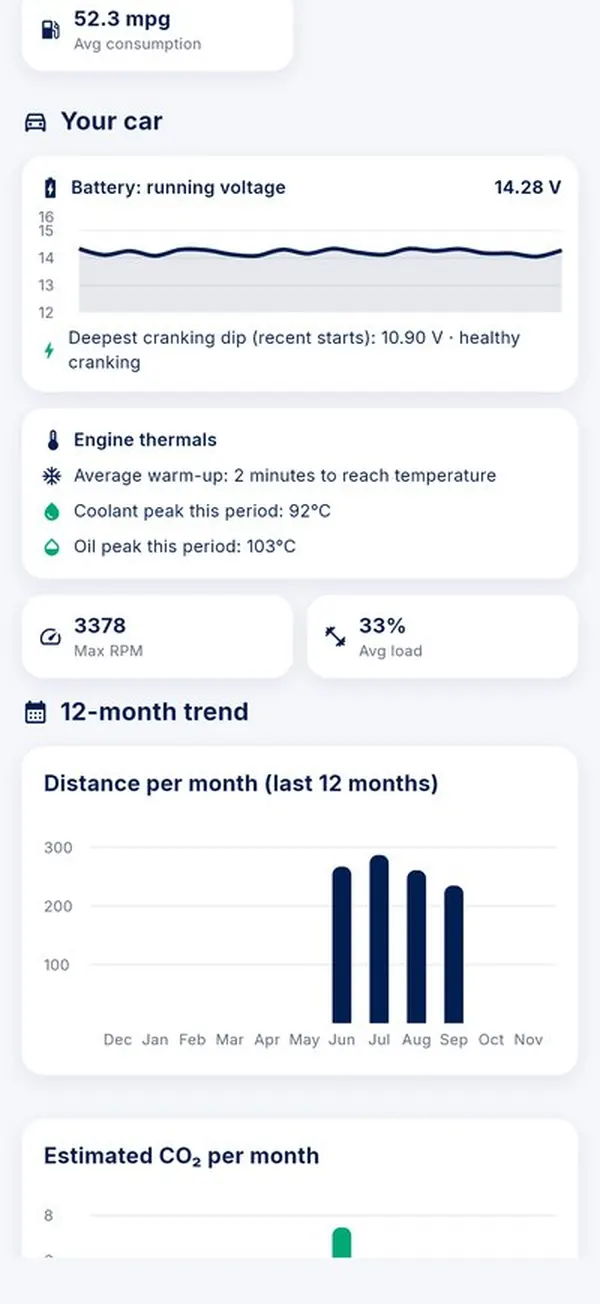
With the engine running, about 13.8 to 14.7 V means the alternator is charging properly. Below 13.4 V, check the battery and the alternator. On recent cars charging is managed by the ECU and the voltage can vary. The trend matters, not a single value.
How do you measure it with a multimeter?
Set the multimeter to DC voltage, 20 V range. With the engine off for a few minutes, put the red probe on the positive terminal and the black one on the negative. Read the value and compare it with the ones above. For the cranking test you need a second person to start the engine while you watch the lowest value, or an app that captures it by itself from the OBD2 port.
Why do batteries die in winter?
In the cold the chemical reactions inside the battery slow down, and it delivers less. At the same time a cold engine, with thicker oil, asks more of the starter motor. A battery that was fine in summer may not make it on the first frosty morning. Short trips make it worse: they don't give the alternator time to recharge it.
Hybrids and electric cars: what changes?
On hybrids and electric cars the electrical system keeps the 12 V battery topped up even with the combustion engine off. For the resting reading, switch the car off completely and let it sit for a few minutes. On hybrids the electric motor starts the engine, so the cranking reading can't be compared with a petrol or diesel car. This page is about the 12 V battery, not the traction battery.
How does DrivePulse show it?
In Health there's a resting battery test and a cranking test. The first guides you through measuring in the right conditions and tells you whether the battery is charged. In the second you tap Start test and start the engine: the app captures the lowest voltage while cranking and gives you a verdict, with a note for hybrids. If cranking gets weaker on your last trips compared with earlier ones, DrivePulse flags it. You can also keep the voltage in view on the Dashboard and on CarPlay while you drive.
Frequently asked questions
How long does a car battery last?
Usually four to six years, less if you mostly do short trips or the car sits for long periods. After four years it's worth checking it at the start of every winter.
Does start/stop drain the battery?
Cars with start/stop use stronger batteries, AGM or EFB. When the charge is low, the system stops switching the engine off at lights to protect it: it's one of the first signs the battery is tired.
What if the car sits for weeks?
A battery maintainer saves you surprises. If you use an OBD2 adapter, unplug it: some stay on even with the engine off.
The app and the multimeter disagree: which one is right?
The multimeter on the terminals. Through the OBD2 port the voltage passes through wiring and the ECU and can read 0.2-0.4 V lower. What matters is the trend over time, comparing readings taken the same way.
How often should you check it?
Before every winter, and more often once it's four years old or if the car mostly does short trips. With the adapter connected, DrivePulse looks at the cranking voltage every time you start and tells you if it drops.
What you need on iPhone
All you need is an ELM327 OBD2 adapter with Bluetooth LE or Wi-Fi, plugged into the diagnostic port, usually under the steering wheel. We recommend the Veepeak OBDCheck BLE or the Vgate iCar Pro 2S. iPhone doesn't see classic Bluetooth adapters. The full list is on Which adapters work.
DrivePulse is read-only: it writes nothing to the ECU and doesn't clear codes. You try it for 7 days from the first connection or for 15 trips, whichever comes first, then unlock it with a single purchase, no subscription and no account.